EU Digital Product Passport · Phase 0 Readiness

Your collection has 125 data gaps you haven't measured yet.

The Digital Product Passport becomes mandatory by mid-2028. We show you exactly where your gaps are. Five days.

5-day turnaround · Zero integration · Works with your existing files
FIBER CONTENT · 350 Not structured BRAND IDENTITY · 100 Partially mapped CERTIFICATIONS · 501 No certs on file SUPPLIER INFO · 200 Tier 1 only COUNTRY OF ORIGIN · 204 Undocumented CARE LABEL · 401 Label only · no digital 125 DATA FIELDS 4 structured · 121 unmapped
125
DATA POINTS
DPP data points per style per the T4V Protocol
Every
EU BRAND
selling textiles in the EU market faces DPP obligations — no exemption by size, revenue, or headquarters location
2027
BUYER SEASON
Wholesale buyers are beginning to require supply chain transparency for collections entering the market in 2027–2028. Your planning window is now.
5
DAYS
from your files to a full readiness dashboard

Four deliverables. Five days.

Everything your team needs to understand your DPP position before enforcement begins.

01
DPP Readiness Score
Per-style fill-rate across 9 data categories. See exactly what percentage of the 125 fields your collection covers, broken down by category and by style.
Know your exact fill-rate per style
02
Certification & Supplier Risk
Cross-references compliance certificates against production routing. Flags expired certs, uncovered factories, and concentration risk before they become enforcement issues.
Surface expired certs and uncovered factories
03
Gap Priority Map
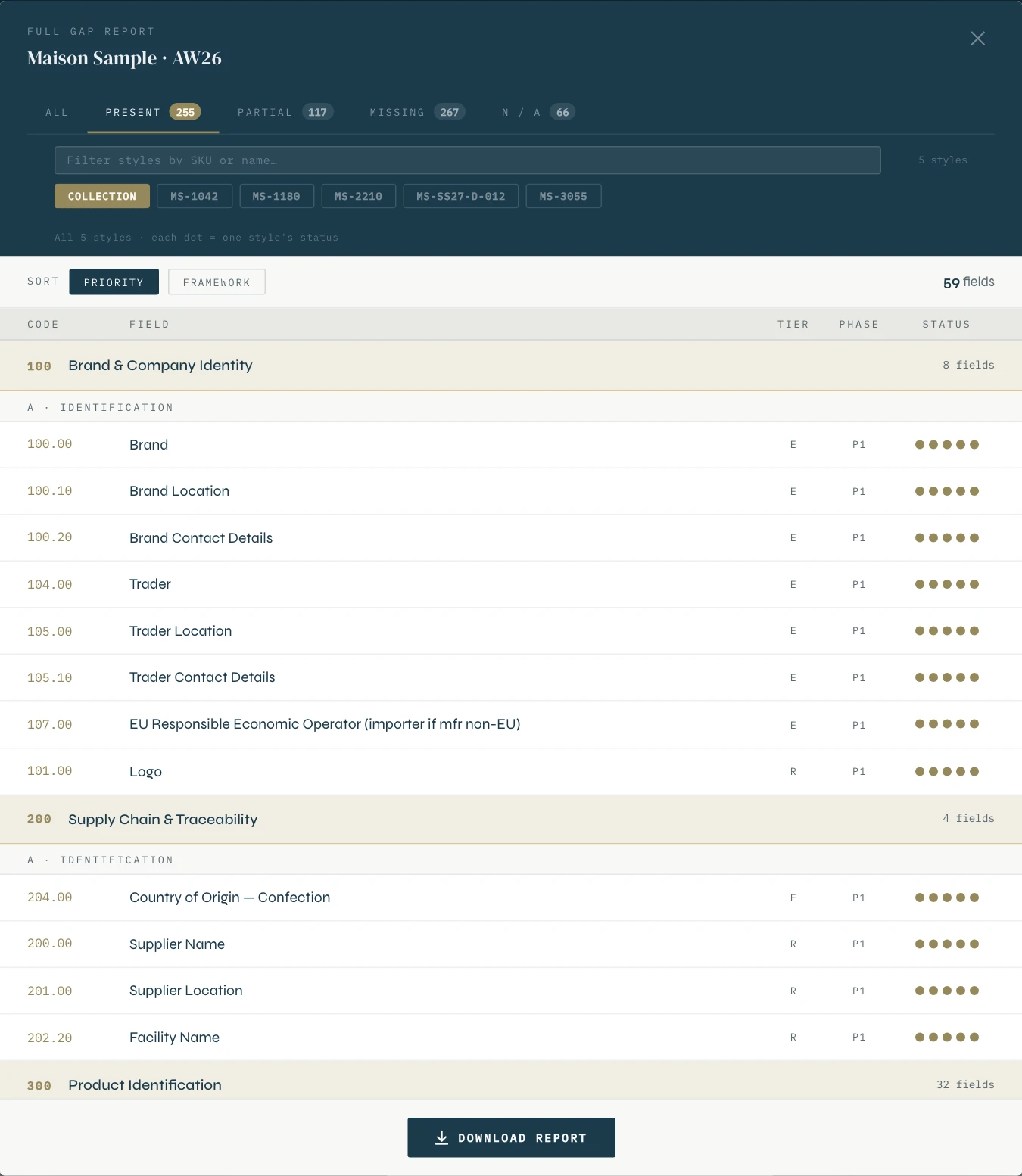
Every missing field mapped to who holds the data, what format it exists in, and estimated effort to collect. Ranked by regulatory phase so your team works the right gaps first.
Prioritized action list by regulatory phase
04
Self-Service DPP Scanner
80-question guided assessment your team completes in 30 minutes. Instant readiness score before any files are shared. Run it before your walkthrough call.
30-minute self-assessment before sharing any files

9 categories. 125 fields.
One structured audit.

Based on the Trace4Value DPP Data Protocol v2 (April 2024) · Developed by TrusTrace, GS1 Sweden, SIS, Kappahl, Marimekko · © SWIN Technologies AB
Brand Sply Prod Matl Dgtl Care Cmpl Circ Sust
CODE CATEGORY FIELDS COVERED FIELDS
100
Brand Information
Brand identity, location, parent company, trader details
16fields
200
Supply Chain Information
Supplier names, facility IDs, country of origin per stage
11fields
300
Product Information
GTINs, commodity codes, pricing, sizing, color, category, weight
32fields
350
Material Information
Fiber composition, recycled content, dye class, finishes, trims
29fields
370
Digital Identifier
Data carrier type, material, location on garment, ISO standard
4fields
400
Care Information
Care symbols, care text, safety information
3fields
500
Compliance Information
Harmful substances, certifications, chemical compliance
10fields
600
Circularity Information
Recyclability, disassembly, repair instructions, take-back
11fields
650
Sustainability Information
Environmental footprint, carbon, water, emissions, waste
9fields
TOTAL FIELDS AUDITED
125fields per style

Five files. Thirty minutes.

Export them from where they already live. Email or shared drive. No system access. No IT team. No procurement approval.

1
Tech Packs
Material specs, construction details, colorways
2
Bills of Materials
Material names, quantities, supplier names
3
Supplier List
Factory names, locations, production types
4
Compliance Certs
OEKO-TEX, GOTS, BSCI, audit reports
5
Product Master
Style names, categories, seasons, prices

Total brand effort: export 5 files you already have. No API access. No IT team. No procurement approval.

Your Head of Production can authorize this in one email.

30 MIN EFFORT · ZERO INTEGRATION · UNDER NDA
Start Your DPP Audit

From raw files to readiness
dashboard in 5 days.

Step 01
Send 5 files you already have
Tech packs, BOMs, supplier list, compliance certs, product master. Email or shared drive — whatever works for you.
30-MINUTE EFFORT · NO IT INVOLVEMENT
Step 02
We map against 125 DPP data points
Field-by-field scoring, gap identification, priority ranking per style and per collection against the T4V protocol.
FIELD-BY-FIELD SCORING · ALL 9 CATEGORIES
Step 03
Walk through your dashboard
60-minute founder-led call showing gaps, risk areas, and your full remediation path. No vague output — a real action plan.
60-MINUTE CALL · FOUNDER-LED
SAMPLE DASHBOARD OUTPUT · DELIVERED IN 5 DAYS
47% DPP READINESS SCORE 48 Present 21 Partial 31 Missing 25 N/A MEDIUM RISK READINESS BY DOMAIN Brand 72% Supply Chain 41% Product ID 58% Material 34% Digital ID 25% Care & Safety 67% Compliance 29% Circularity 11% Sustainability 0% PHASE 1 GAPS [350.21] Fiber Content Value [204.00] Country of Origin [501.00] Certifications → 28 Phase 1 fields require immediate attention 827 DAYS TO ENFORCEMENT mid-2028 mandatory
Interactive dashboard + downloadable PDF. Founder-led walkthrough call included.
Total brand effort: export 5 files you already have. No API access. No IT team. No procurement approval.

The clock is already running.

July 2024
ESPR entered into force
Ecodesign for Sustainable Products Regulation — the legal foundation for DPP
April 2025
EC Working Plan — textiles confirmed priority
European Commission formally identifies textiles as a priority product category
Apr 2026
YOU ARE HERE
Months to mandatory enforcement — updated automatically. Brands that begin DPP data structuring now will enter the 2026 registry window ahead of peers.
19 July 2026
EU DPP registry goes live
The centralized EU registry infrastructure becomes operational (Art. 13 ESPR). The technical foundation for all product passport registration is live — textile-specific DPPs follow after the Delegated Act is adopted.
September 2026
Green claims rules take effect
EU Regulation (EU) 2024/825 prohibits unsubstantiated sustainability claims across the EU. Brands must back every green claim with verified product data — the same data a DPP requires. No exemption by size or sector.
Late 2026
Delegated act for textiles expected
Final field requirements and format specifications published — no more rule changes after this
Mid-2028
Mandatory enforcement begins
DPP required for all new textile products placed on the EU market — non-compliance carries market access risk
2030
Full implementation, all categories
DPP requirements extend across all product categories under ESPR
Brands that start structuring data now will be 18 months ahead of brands that wait for final rules.

What 12 months of head start looks like.

Start Now
  • Structure data across 2–3 collections at your pace
  • Meet buyer and retailer requests for supply chain transparency — ahead of their own deadlines
  • Build supplier compliance documentation proactively
  • Enter enforcement window with a 12-month head start
Start in 2027
  • Scramble to structure 5+ seasons of backlog data under pressure
  • Pay 5–10× more for emergency compliance consulting
  • Face rushed compliance under regulatory scrutiny

From gaps to structured data.

Scope, pricing, and timeline are tailored to your collection after the readiness walkthrough.

01 EXPLORATORY
DPP Readiness Audit
Your collection scored and gaps mapped across all 125 fields. Delivered in 5 days.
02
Remediation Plan
We scope exactly what it takes to close each gap — who holds the data, what format, and what effort.
03
Ongoing Structuring
New collections. Updated compliance. Season after season — DPP maintained as a live, audit-ready data layer.
The readiness audit is free. Structured remediation and ongoing support are paid engagements — scoped and quoted after your audit walkthrough.
Scope, pricing, and timeline are tailored to your collection after the readiness walkthrough. No commitment required to proceed.
Alternative Path
See your readiness score in 30 minutes.
Run our DPP Gap Scanner. 80 screening questions across 9 DPP categories — no files needed. For a field-by-field assessment of all 125 data points, request the audit.
RUNS IN YOUR BROWSER · NO DATA STORED WITHOUT CONSENT
Launch the DPP Gap Scanner →
LGFL · PHASE 0 PRODUCT Brand & Company Identity (100) 0/16 answered [100.00] Brand Phase 1 Urgent Can you provide the primary brand name as it appears on the garment? We have this Partially We don't have this 80 screening questions · 9 categories · 5 languages

Not sure where you stand?

Send us 5 files your production team already has. We map every style against the 125-point Trace4Value protocol and walk you through your findings — at no cost, for up to 12 styles. You see exactly where your gaps are before deciding on anything.

Start Your DPP Audit

See where your collection stands.

Join EU brands already mapping their DPP readiness. Five-day turnaround. Founder-led walkthrough. Under NDA from day one.

5-day delivery guarantee
NDA signed before any files are shared
No system access required
Zero integration or IT involvement
No commitment required

By submitting you accept our Terms & Conditions and confirm you have read our Privacy Policy.

Your production data is confidential. We never share brand-specific information. All engagements are under NDA.
SECTION 07

Frequently Asked Questions

What EU fashion brands need to know about the Digital Product Passport.

What is the EU Digital Product Passport (DPP) for fashion?
The EU Digital Product Passport is a regulatory requirement under the Ecodesign for Sustainable Products Regulation (ESPR). It will require every textile product sold in the EU to carry a machine-readable digital record containing verified data on materials, supply chain, environmental impact, compliance, and circularity. The delegated act for textiles is expected late 2026 / early 2027, with mandatory compliance by mid-2028.
When is DPP mandatory for fashion brands in the EU?
The EU delegated act for textiles is expected to be published in late 2026 or early 2027. Following an 18-month transition window, mandatory enforcement is targeted for mid-2028. Phase 1 fields (material composition, basic traceability, chemical compliance) will be required first; Phase 2 fields (environmental footprint, circularity) follow.
Are buyers already requesting DPP data before the 2028 deadline?
Yes — in two ways. First, from September 2026, EU Regulation (EU) 2024/825 prohibits unsubstantiated green claims across the EU. Any sustainability claim a brand makes — to consumers, buyers, or platforms — must be backed by verified product data. This applies regardless of the textile DPP deadline. Second, EU retailers and platforms are already integrating supply chain transparency requirements into their buyer terms and supplier qualification processes, ahead of ESPR enforcement. Brands with structured DPP data are better positioned for wholesale access today, not just compliant in 2028.
What is a DPP Readiness Audit?
A DPP Readiness Audit is a structured assessment of a brand's existing production data against the 125 data points required by the EU Digital Product Passport. LGFL's audit benchmarks against the Trace4Value DPP Data Protocol v2 — the most granular industry-consensus specification — and quantifies gaps across nine data categories: brand, supply chain, product, material, digital identifier, care, compliance, circularity, and sustainability.
What is the Trace4Value DPP Data Protocol?
The Trace4Value DPP Data Protocol is a 125-data-point specification for textile Digital Product Passports developed by TrusTrace, GS1 Sweden, SIS (Swedish Institute for Standards), Kappahl, and Marimekko. Published in April 2024 (© SWIN Technologies AB), it organizes DPP data into 9 categories and is the most detailed industry-consensus benchmark currently available pending the EU delegated act.
How long does an LGFL DPP Readiness Audit take?
Five business days from intake to delivery. The brand exports five file types they already have (tech packs, BOMs, supplier list, compliance certificates, product master) — a 30-minute task — and LGFL delivers a per-style readiness dashboard with quantified gaps and a prioritized remediation map.
Can German brands subsidise the audit cost through BAFA?
This applies to German-registered companies only. German SME clients may be able to offset part of the engagement fee through the federal BAFA Förderung unternehmerischen Know-hows programme, which subsidises external consulting services for qualifying companies. Eligibility depends on company age, size, and location. Contact us before booking and we will advise on whether your engagement is likely to qualify.
Is LG Fashion Labs related to LG Electronics?
No. LG Fashion Labs (LGFL) is an independent Munich-based fashion technology company. The "LG" in our name refers to founder Lior Gabriel Graetz. LGFL has no affiliation with LG Electronics, LG Corp, or any LG-branded consumer electronics or fashion lines.
DPP COMPLIANCE GUIDES

Continue reading

This website uses no cookies and no external fonts.  Details