01 / DPP COMPLIANCE GUIDE
The Digital Product Passport for Fashion: The Complete 2026 Guide
Expected from 2028, every textile product newly placed on the EU market must carry a Digital Product Passport with verifiable data on materials, supply chain, compliance and circularity. The textile delegated act is expected in 2027 — a Commission proposal is possible as early as late 2026. Most European growth brands today hold only a fraction of the required data in structured, audit-ready form.
This guide explains what the EU Digital Product Passport (DPP) means for the fashion industry, why it is coming, which data will be required, when compliance becomes mandatory, and what fashion brands should do now — before the delegated act is finalised. It is based on the current state of the Ecodesign for Sustainable Products Regulation (ESPR, Regulation (EU) 2024/1781), the April 2025 ESPR Working Plan, and the LGFL DPP Data Framework — the most granular industry specification currently available.
1. What is the Digital Product Passport?
The Digital Product Passport (DPP) is a machine-readable digital record permanently linked to a physical textile product. Consumers, authorities, recyclers and resellers access it via a data carrier on the product — typically a QR code, alternatively NFC or RFID.
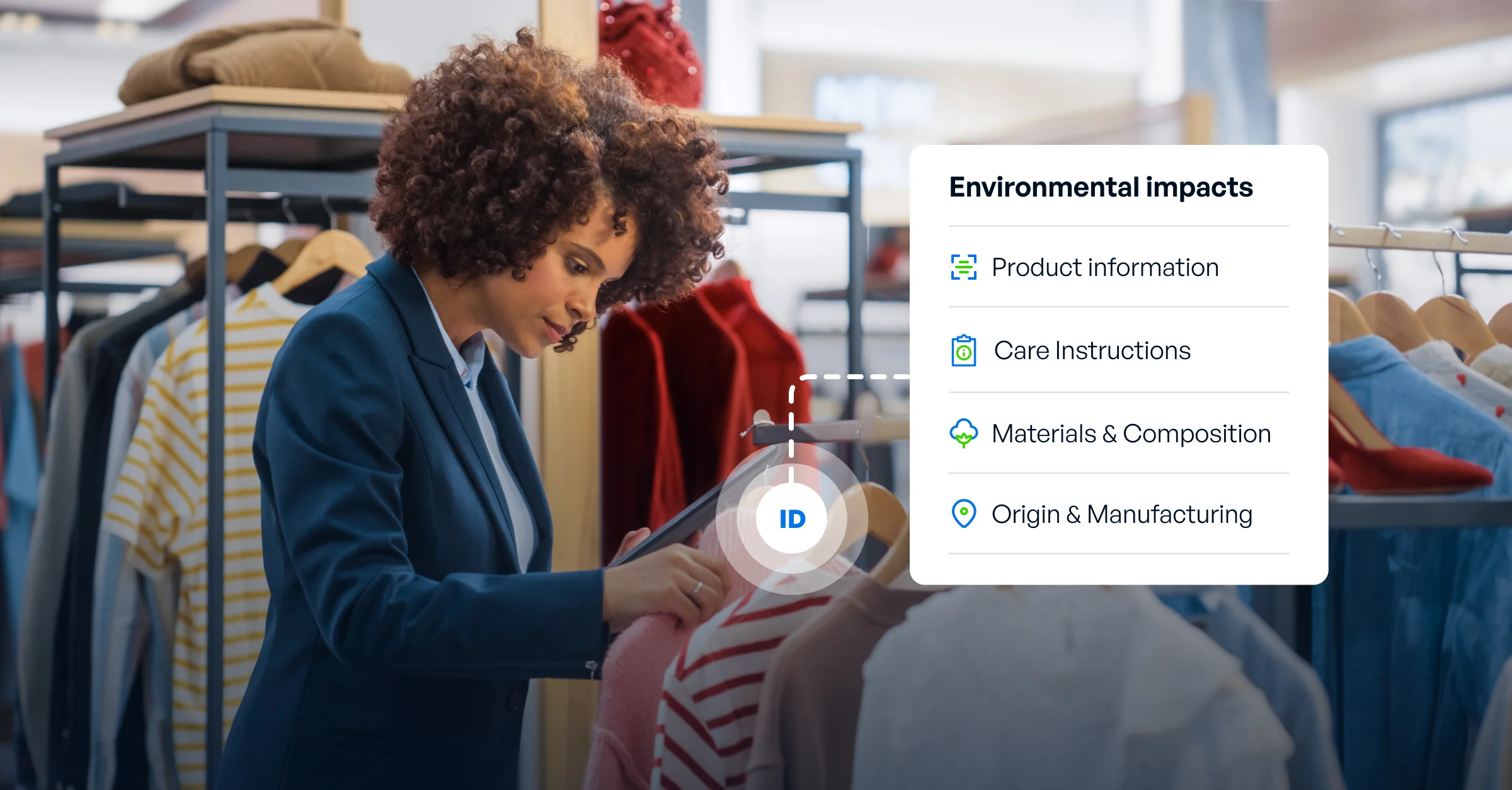
The DPP contains information on: brand identity and the EU responsible economic operator, full material composition per component, supply chain including the weaving, dyeing and assembly stages, care and safety information, compliance and certification data, circularity strategy and repair information, and quantified environmental indicators.
The DPP is not a marketing surface and not a voluntary transparency initiative — it is a regulatory requirement. Fashion brands that want to sell products in the EU after the delegated act's transition period must provide a complete DPP — or lose market access.
2. Why is the DPP coming — and why now?
The DPP is part of the European Green Deal and the EU Strategy for Sustainable and Circular Textiles (March 2022). According to the European Commission and the European Environment Agency (EEA), EU textile consumption has on average the fourth-highest environmental and climate impact of all consumption categories — after food, housing and mobility — ranks third for water and land use, and fifth for raw material use and greenhouse gas emissions. Between 4 and 9 percent of all textile products placed on the EU market are destroyed without ever being used; globally, less than 1 percent of textiles are recycled into new textile products.
The legal basis is the ESPR, in force since July 2024. It replaces the old Ecodesign Directive and extends its scope from energy-related products to nearly all physical products. In April 2025 the Commission adopted the ESPR Working Plan 2025–2030, confirming textiles as a priority product category.
The timeline: the textile delegated act — which sets the final data requirements — is expected in 2027; a Commission proposal is possible as early as late 2026. After a transition period of an expected 18 months, mandatory application begins — expected from 2028. A brand that waits for the final rules has effectively 18 months from their publication to build a data structure that must be maintained consistently across several concurrently running seasons. For most brands, that is not enough.
3. What data must a textile DPP contain?
The final dataset will be defined by the delegated act. Until then, the LGFL DPP Data Framework anchors brand readiness to the EU's four ESPR legal-basis categories (ESPR Annex III + Article 7), structured for the CEN/CENELEC JTC 24 standards (EN 18219, EN 18220), informed by CIRPASS, and cross-referenced against the Trace4Value protocol (TrusTrace / GS1 Sweden / SIS, April 2024) — the most granular open industry list to date. It organises fields across 10 domains nested under those four categories:
100 — Brand and company (16 fields): brand name, registered office, parent company, EU responsible operator, distributor information. 200 — Supply chain and traceability (11 fields): tier-1 suppliers with full addresses, facility identifiers in a recognised registry (e.g. GLN), country of origin for assembly, dyeing and weaving. 300 — Product identification (32 fields): GTIN or serialised product IDs, HS codes, sizes, colours, style category, season, weight, pricing information. 350 — Materials and composition (29 fields): fibre composition per component with percentages, recycled and renewable shares, leather origin, dye class, finishes, trims. 370 — Digital identifier (4 fields): data carrier type (QR, NFC, RFID), carrier material, position on product, conformity with ISO/IEC 15459. 400 — Care and safety (3 fields): care symbols per ISO 3758, care text, safety warnings. 500 — Compliance and chemical safety (10 fields): substances of concern above the 0.1% threshold, certification data (GOTS, OEKO-TEX, GRS), REACH/ZDHC conformity, microplastics disclosure for synthetic-dominated products. 600 — Circularity (11 fields): recyclability, take-back programmes, disassembly guidance for sorters and consumers, repairability, circular design strategy. 650 — Sustainability and environmental impact (9 fields): quantified carbon footprint, water use, emissions, waste volumes, energy intensity.

For fashion brands this means: most already hold parts of this data — scattered across tech packs, bills of materials, supplier lists and compliance certificates. The effort lies not in collecting data from scratch, but in structuring, verifying and linking these records across every style in a collection.
4. The expected phased rollout
Industry standards and the consultation documents to date suggest DPP requirements will be introduced in stages — starting with fields for which established standards and verification mechanisms exist.
Phase 1 — expected from the start of mandatory application (from 2028): brand identity and responsible operator, full fibre composition, tier-1 supplier data and countries of origin per production stage, care and safety information, chemical compliance confirmations, data carrier and identifier.
Phase 2 — expected in subsequent extension rounds: quantified environmental footprint per the PEF method, detailed circularity metrics, repairability scores, take-back and recycling instructions, extended microplastics disclosure.
This phase structure is not officially fixed and may change with the delegated act. Brands should nevertheless assume Phase 1 fields must be in place by the compliance date.
5. What does this mean for your brand in practice?
First: you need every data point per style — not per brand. The DPP is a product-specific record. A brand with five collections per year and 80 styles per collection manages 400 separate DPP records annually, each covering all fields of the LGFL DPP Data Framework. That is maintainable only with structured data architecture, not with Excel lists.
Second: your suppliers must come along. By LGFL's estimate, around one third of DPP fields can only be sourced from suppliers — material composition with sourcing evidence, dyeing process data, fabric-level countries of origin, chemical test reports. Brands without structured supplier onboarding will be negotiating with dozens of suppliers in parallel in 2027.
Third: data without evidence will not survive scrutiny. DPP fields are provided by the brand as the responsible economic operator — but must be substantiated by source documents: bills of materials, material test reports, supplier certificates, audit reports. Market surveillance can demand evidence. Brands maintaining data without source linkage risk sanctions and sales stops on official review.
6. Common misconceptions about the DPP
"We already have a traceability solution — that's enough." Typical traceability platforms cover only part of the DPP fields — primarily the supply chain layer. They do not replace structured capture of material data, compliance certificates, care information and circularity data across all fields of the LGFL DPP Data Framework.
"The DPP is only relevant for big brands." Wrong. The ESPR provides no size exemption for the DPP. Every textile product on the EU market — regardless of brand size — needs a complete DPP.
"We don't produce in the EU, so this doesn't apply to us." The DPP applies to all products placed on the EU market — regardless of production country. Turkish, Moroccan or Asian production changes nothing about the compliance obligation once the product is sold in the EU.
"We'll wait for the final regulation, then react." That is the most expensive strategy. After the delegated act is published, roughly 18 months remain to build data architecture, supplier communication and internal processes — for several already-running seasons simultaneously. Brands that start now gain a 24-to-30-month head start.
7. What fashion brands should do now
Step 1 — Measure readiness. Assess one complete current collection against the fields of the LGFL DPP Data Framework. Which fields do you hold structured, which partially, which not at all? This baseline underpins all further planning. A DPP Readiness Audit answers this question.
Step 2 — Start supplier onboarding. Identify the fields that can only come from suppliers and begin structured data requests — starting with your strategically most important tier-1 suppliers. A supplier data sheet with the 30–40 core fields is enough to start.
Step 3 — Build data architecture. If today you manage tech packs as PDFs, BOMs in Excel, certificates as email attachments and supplier lists in Notion, you will need a structured data foundation by 2027. Start with the question: "Where does each DPP data point live today, and how is it updated per new collection?"
DPP AUDIT
How ready is your collection for the DPP?
Benchmark one complete collection against the LGFL DPP Data Framework. 10 domains, four ESPR categories. Under NDA.
Start Your DPP Audit