01 / DPP READINESS AUDIT
DPP Readiness Audit Explained: How Fashion Brands Measure Their Preparation
A DPP Readiness Audit answers a single question: What percentage of the data the EU Digital Product Passport will require by mid-2028 does your brand already hold in structured, audit-ready form? That number is your baseline. It determines how much lead time you actually have — and where you need to invest first.
This guide explains what a DPP Readiness Audit is, the methodology behind it, how to prepare for DPP fashion brand compliance, how a self-assessment differs from a professional audit, and which weaknesses European mid-market fashion brands most frequently reveal in practice. It is written for Heads of Production, Sustainability Managers, and executives who need a solid foundation for their DPP strategy — before investing in platforms, consultants, or tools.
1. What Is a DPP Readiness Audit?
A DPP Readiness Audit is a structured assessment of a fashion brand’s existing production data against the data-requirement catalog of the EU Digital Product Passport. The auditor evaluates which of the required data points are present, in what quality they exist, and which are missing or only partially documented.
The result is a quantified statement: a readiness percentage, broken down by data category, by regulatory phase, and ideally also per style or style group. A good audit delivers not only the score but also a prioritized gap list — sorted by which fields must be closed first, which suppliers need to be involved, and what effort per gap is realistic.
Important: A DPP readiness audit fashion assessment is not a compliance confirmation. It is a diagnosis. It does not confirm that a brand is ESPR-compliant (that will only be possible from mid-2028 onward, once the delegated act applies) — it shows which preparation steps are pending and in what priority order.
2. Why Audit Now — Not in 2027?
Three arguments:
Data structures take time. A complete DPP data set for a collection of 80 styles comprises a large set of structured data points. Some of this data already exists — spread across tech packs, Bills of Materials (BOM), supplier lists, compliance certificates, and product masters. Structuring it, linking it, and maintaining it consistently across seasons is an architecture decision. You cannot build that architecture in 18 months while running five concurrent seasons.
Suppliers need lead time. At least one third of DPP fields can only come from the supplier — material composition with sourcing documentation, dyeing process data, countries of origin at the fabric level. An audit reveals which of these fields your current suppliers already hold in structured form and where you need to migrate 50 to 200 suppliers to new data formats in parallel.
Design decisions for SS28 are being made now. If the Ecodesign for Sustainable Products Regulation (ESPR) introduces minimum shares of recycled fibers or mono-material requirements, those affect design decisions being made today for the 2027 and 2028 collections. An SS28 collection designed in 2026 without anticipating these requirements can only be adjusted later at significant cost.
Brands that wait until after the delegated act is published in late 2026 / early 2027 to begin measuring readiness will have roughly 18 months for a task that typically requires 24 to 36 months of lead time. Since fashion DPP 2028 enforcement leaves no room for delays, starting an audit now buys that time window.
3. How Is DPP Readiness Measured?
The LGFL DPP Data Framework defines fields of the LGFL DPP Data Framework per style across 10 domains, aligned with ESPR Annex III and the JRC textile preparatory study. It cross-references the Trace4Value protocol (TrusTrace / GS1 Sweden / SIS, April 2024) — the most granular open industry list to date.
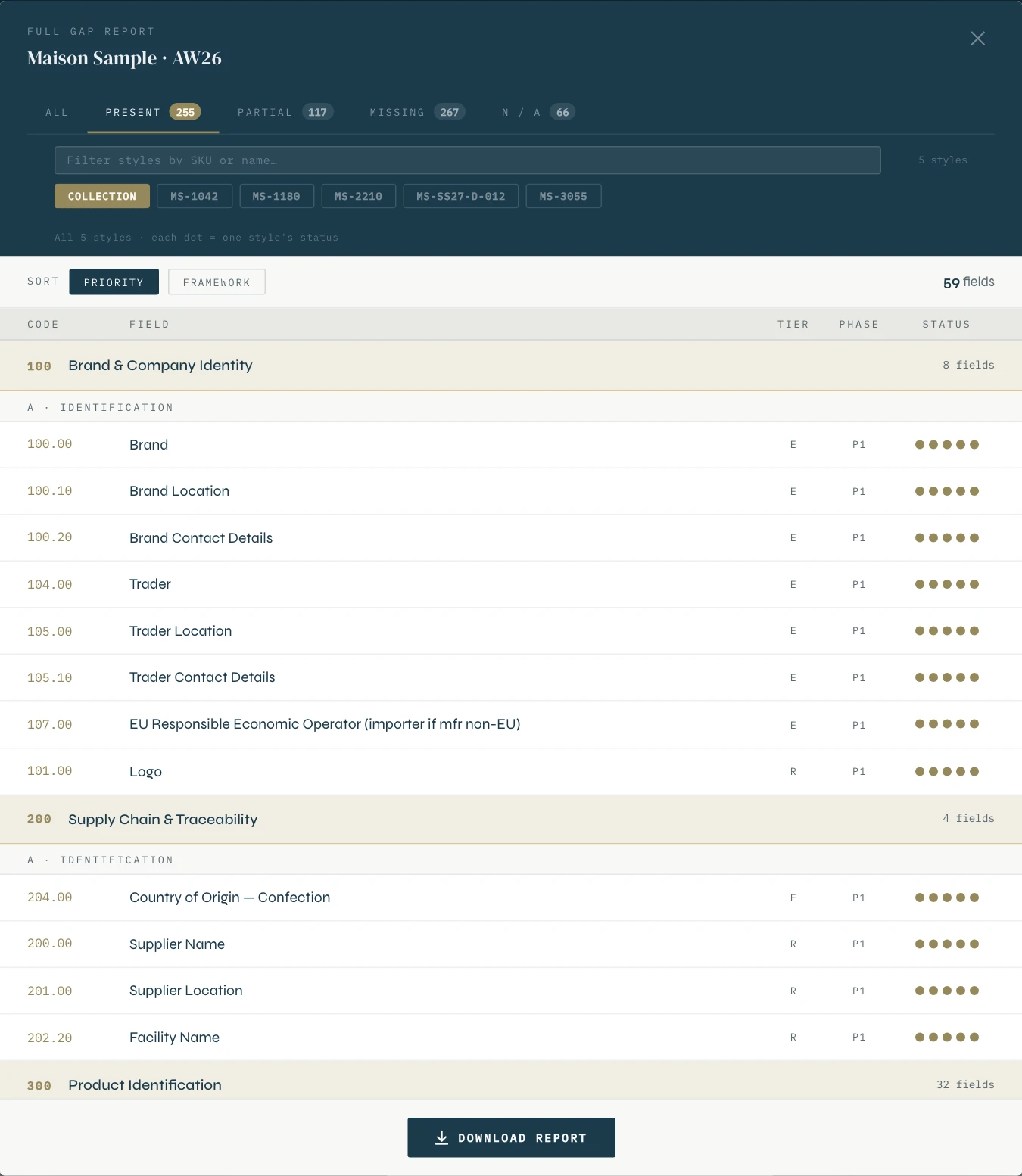
A DPP Readiness Audit following this methodology rates each of the fields of the LGFL DPP Data Framework in one of three states:
Present. The field is documented in structured, audit-ready form with source linkage. Example: “Material composition is documented in the tech pack with percentage data and backed by a material test report from an accredited lab.”
Partial. The field is captured but not at the quality required for DPP compliance. Example: “Supplier name is listed in the spreadsheet, but without a registered facility identifier (GLN) and without address verification.”
Missing. The field is not documented at all or exists only in unstructured form (such as an email thread or a PDF without structured data extraction).
This approach reveals DPP data readiness fashion brands must address before enforcement. From these ratings a weighted readiness score is calculated: present fields count in full, partial fields at half weight, missing fields at zero. The result is a percentage expressing the DPP readiness of the assessed product set.
A good audit shows this score not only in aggregate but broken down by all nine data categories — because the distribution says more than the overall score. A brand with 60% overall readiness may be fully prepared in four categories and have nothing in five, revealing critical digital product passport data gaps fashion brands need to close before enforcement.
4. The 10 Domains in Detail
The framework structure. The LGFL DPP Data Framework is organised under the EU's own four ESPR legal-basis categories — Annex III + Article 7 — with ten domains nested as the audit lens.
Foundational / System Layer — Data Carrier (370). Governed by CEN/CENELEC JTC 24 (EN 18219 identifiers, EN 18220 carriers). The physical carrier (QR / NFC / RFID) and ISO encoding — not a content domain.
Category A — Identification (ESPR Annex III b–d, g–k).
Domain 100 · Brand & Company Identity. Brand identity, parent company, sub-brand hierarchy, trader, EU Responsible Economic Operator (107.00) — the ESPR Article 4 accountability anchor; for non-EU manufacturers, the EU-side importer. Typical readiness: high.
Domain 200 · Supply Chain & Traceability. Tier 1 suppliers with facility registries (GLN), Unique Facility Identifier (UFI), Unique Operator Identifier (UOI), and country-of-origin per ESPR production stage (confection / dyeing & printing / weaving & knitting). Typical readiness: low (Tier 1 mostly available, Tier 2 rarely).
Domain 300 · Product Identification. Unique Product ID (UPI, serialised GTIN), GTIN/EAN, TARIC/HS, sizes, colours, categories, seasons, pricing. Typical readiness: medium-high.
Category B — Product-specific parameters (ESPR Art. 7(2)(b)). The performance layer — JRC Design Options DO1–DO4.
Domain 350 · Material & Composition. Component-level fibre composition, recycled inputs, leather/dye/finish specifications. Houses DO3 recycled-content threshold (351.10) — the one mandatory performance threshold. Typical readiness: low–medium.
Domain 660 · Durability & Physical Performance — NEW 10th domain. Home for DO1 robustness score (0–10), test basis, reliability, expected lifespan. DO1 measures laundering resistance, not real-world lifetime. Source: JRC 3rd Milestone DO1; EN 45552. Net-new — not in the base traceability scaffold. Typical readiness: very low.
Domain 600 · Circularity & End-of-Life. Recyclability, take-back, disassembly, repair, circular strategy. Houses DO2 recyclability score (601.00) — 0–10; >15% elastane → 0 (non-recyclable) per proposed method. Source: EN 45555; EU CEAP. Typical readiness: very low.
Domain 650 · Sustainability & Environmental Impact. Houses DO4 environmental footprint (651.00, PEF single score) — voluntary, excellence-only (only displayable if product beats the PEFCR category benchmark). Source: PEF Rec. (EU) 2021/2279. Typical readiness: very low.
Category C — Substances of Concern (ESPR Art. 7(5) + Art. 2(27)). Promoted to a first-class category in its own right.
Domain 500 · Substances of Concern — restructured. A structured object, not a single "cert on file" flag: substance name (IUPAC) · CAS/EC number · location in product (per article/component) · concentration (per delegated act threshold; not hard-coded 0.1% w/w — that is the SCIP/REACH precedent, not confirmed for textiles) · criterion (a SVHC · b CLP-chronic · c POPs · d recycling-impeding) · end-of-life handling. SVHC threshold applies per article/component, not per garment. The SCIP/CSRD-recommended layer (intentionally-added flag · function · lifecycle stage · SCIP notification reference · recovered-material substances) is restricted-access. Typical readiness: low.
Category D — Information under other Union law (ESPR Annex III a, e, f).
Domain 400 · Care & Safety. Care symbols (ISO 3758), care text, safety information. Predates ESPR (Reg. (EU) 1007/2011). Stable. Typical readiness: high.
Domain 501–506 · Compliance & Certifications. REACH/ZDHC compliance, voluntary certs (GOTS/OEKO-TEX/GRS), microplastic disclosure, traceability/DPP service provider, and the EU Declaration of Conformity (506.00) — the formal conformity attestation that the DPP carries under ESPR. Typical readiness: medium.
Scope. Applies to apparel that is at least 80% textile fibres by weight. Footwear is currently out of scope per the JRC content study.
Marketplace clause. Selling through a marketplace (Amazon, Zalando and similar) does not transfer the DPP obligation. The brand — or the EU-side importer where the manufacturer is non-EU — remains the legally responsible economic operator under ESPR Article 4.
How the data handover works
Five files most brands can pull directly cover the audit baseline: tech packs, bills of materials, supplier list, compliance certificates and product master. Send each file whole and unedited — do not delete fields or re-key into templates. The data points listed for each file are what we look for inside the complete file, not a list to extract. Once you confirm the handover is complete, anything that exists in your systems but wasn't included is recorded as missing rather than not-applicable, which affects your readiness score. We sign an NDA before any sharing. Two delivery options: (A) you export and place all files in a shared folder with read access, or (B) you grant LGFL read- and export-only access to your live PLM/ERP/shared drive, so we pull what we need and see your data structure first-hand.
These distributions are estimates based on observations of European mid-market brands in the revenue range of 5 to 50 million euros, and they highlight why an affordable DPP solution fashion brand teams can adopt early makes a measurable difference. Larger brands with dedicated sustainability teams typically score higher; younger D2C brands often score lower.
5. Choosing Among Top DPP Providers Fashion 2026: Self-Assessment vs. Professional Audit
There are two ways to conduct a DPP Readiness Audit — both have merit, but very different informational value.
Self-assessment. A brand answers a structured questionnaire — typically 80 to 130 yes/no/partial questions — about its own data situation. Advantages: fast (typically 20 to 30 minutes), no data sharing with third parties required. Disadvantages: subjective (what a brand considers “structured” may not hold up to a DPP audit review), no deep inspection of actual data, no external validation.
A self-assessment is useful as a first step — it reveals broad gaps and provides an initial baseline. It does not replace an audit for strategic investment decisions.
Professional audit. An external auditor examines a brand’s actual data sources — tech packs, Bills of Materials, supplier lists, compliance certificates, product masters — against the requirement catalog. Advantages: objective, uncovers gaps that self-assessments miss, provides external validation that is credible for internal stakeholders (management, board) and external stakeholders (investors, banks). Disadvantages: requires data sharing (typically under NDA), time investment from the brand (providing files), cost for external audits typically in the low four-figure range per collection.
A pragmatic sequence: Start with a self-assessment — such as the LGFL DPP Gap Scanner — to identify the broad gaps. If the result is below 50% or if you need external validation for internal investment decisions, follow up with a professional audit for a full collection.
6. What a Good Audit Delivers
A professional DPP Readiness Audit should include the following deliverables:
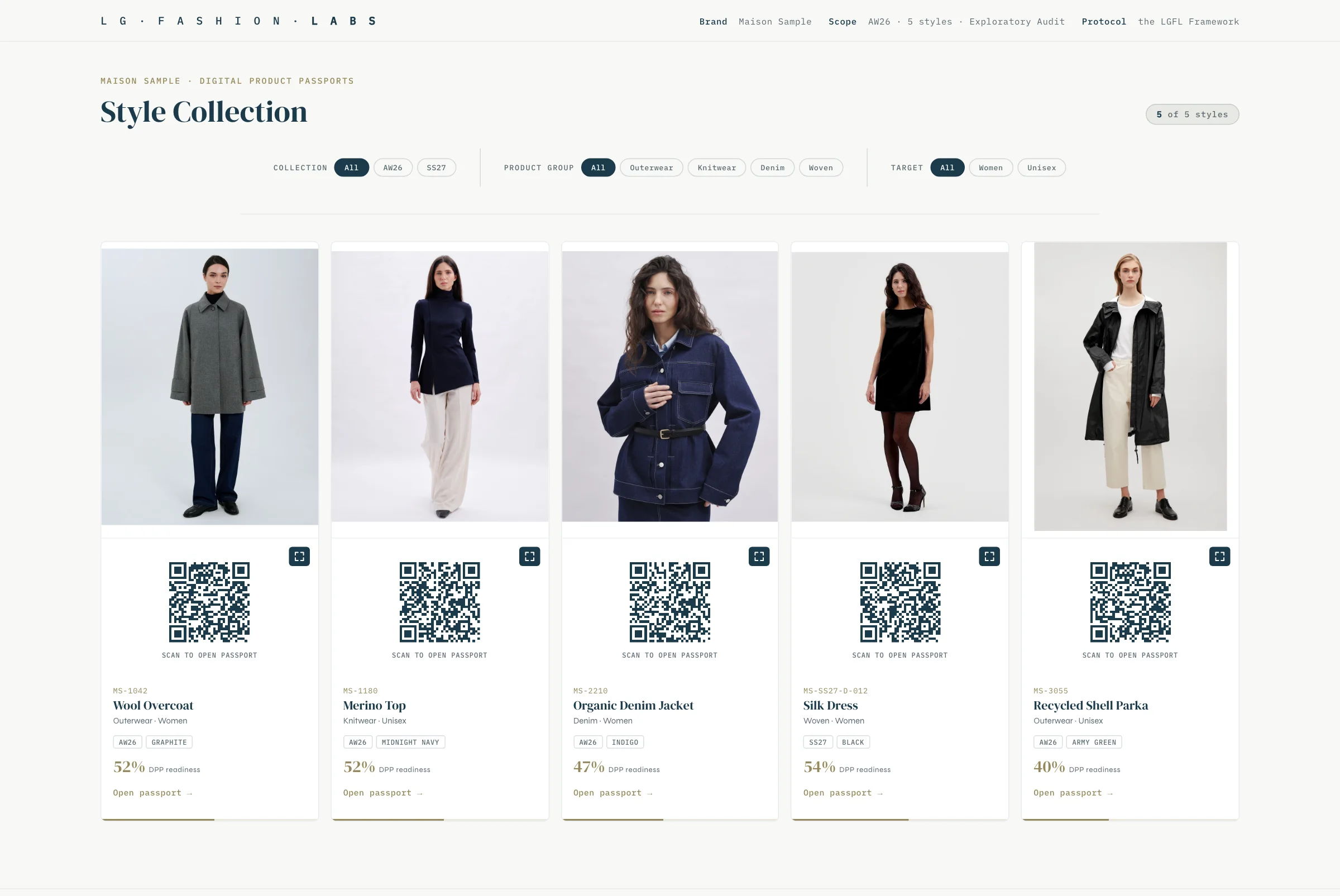
Quantified overall score. Percentage of DPP fields that are present in structured form, weighted across all fields of the LGFL DPP Data Framework and all assessed styles.
Score breakdown by category. What is the readiness in each of the nine data categories?
Score breakdown by phase. How many Phase 1 fields (mandatory from mid-2028) are present? How many Phase 2 fields?
Per-style assessment. Which styles are best/worst documented? It is common to find that certain product groups or suppliers are structurally weaker.
Supplier risk map. Which suppliers already hold structured data today? Which need to be onboarded? Which pose compliance risks?
Prioritized gap list. Each missing data category with: which fields are missing exactly, who typically holds the data, in what format it usually exists, what effort is realistic for structuring, which phase priority applies.
Concrete action plan. A DPP compliance roadmap fashion brand teams can execute, identifying which three to five steps will deliver the largest readiness increase in the next 90 days.
An audit that only delivers a score without this breakdown is not actionable. You know where you stand — but not what to do next.
7. Common Weaknesses in European Mid-Market Brands
From practice: three gap patterns that appear especially often in DACH and other European mid-market brands.
First — Tier 2 data is almost always missing. Brands know their assembly suppliers (Tier 1) but rarely their fabric mills (Tier 2) and almost never their fiber suppliers (Tier 3). The DPP requirement “Country of Origin — Weaving” therefore becomes the largest structural gap. No new system helps here — what is needed is structured supplier communication over twelve to eighteen months.
Second — Compliance certificates are unstructured. OEKO-TEX, GOTS, or REACH certificates typically exist as PDF attachments in email correspondence. They are not linked to product styles in a machine-readable way. During an audit or a regulatory inquiry they must be manually compiled — which takes days for 80 styles per collection and 40 suppliers.
Third — Circularity data does not exist. Recyclability, take-back program, disassembly instructions, repair instructions — these fields are at zero for many brands. They require design decisions that must be made today and communication content that must be developed per style. Sustainability teams at most brands are not large enough for this task without systematic support.
EXPLORATORY AUDIT
How ready is your brand for the Digital Product Passport?
Use the DPP Gap Scanner to measure your current data coverage against the fields of the LGFL DPP Data Framework of the LGFL DPP Data Framework — in 30 minutes, not weeks.
Start Your DPP Audit